
No Official Fillmore Mugshot Gallery Was Located
Official research did not locate a Fillmore County sheriff mugshot gallery, recent-bookings page, or current jail roster with booking photos. That matters because a reader should not expect to open a county page and browse arrest photos. The local path is the Fillmore County Sheriff's Office at 900 G Street in Geneva, phone 402-759-4441, fax 402-759-4429, mailing address PO Box 266, Geneva, NE 68361. The sheriff page names Sheriff Mark McFarland and lists Mel Coetzee as Correction Supervisor, but it does not publish a photo roster, retention window, photo download function, or booking-photo search field.
The county site does have a public-records navigation point, and Nebraska law gives a stronger records basis than many states for asking about arrest-identification photographs. A request should still be specific and practical. Ask whether a booking photo exists for the named arrest, whether it is releasable, whether a written public-records request is required, and whether the office charges copying or processing fees. The county did not publish a sheriff-specific fee schedule or processing timeline in the research materials, so the office should be asked directly.
How to Find or Request a Fillmore County Booking Photo
There is no located official online gallery to search by name, booking date, or charge. The request path starts with current-custody confirmation and then moves into public records if the photo is not available through a direct jail inquiry.
- Call the Fillmore County Sheriff's Office at 402-759-4441 to confirm whether the person was booked locally and whether the person is still in custody.
- Ask whether a booking photo was taken and whether the sheriff releases booking photos through a public-records request.
- Prepare the identifying details: full name, date of birth if known, arrest date, booking date, case number if known, and arresting agency.
- Submit the request through sheriff channels: phone, fax 402-759-4429, mail to PO Box 266, Geneva, NE 68361, or in person at 900 G Street during posted office hours.
- If the person has moved to state prison, search NDCS for state-prison identity and custody details, but do not treat NDCS as the source for the original county booking photo.
- For federal custody, use BOP or federal court channels for location and case context. BOP and U.S. Marshals public tools generally do not operate like county mugshot galleries.
The Fillmore County public-records page is thin, but it confirms that public records are part of the county website's official navigation.
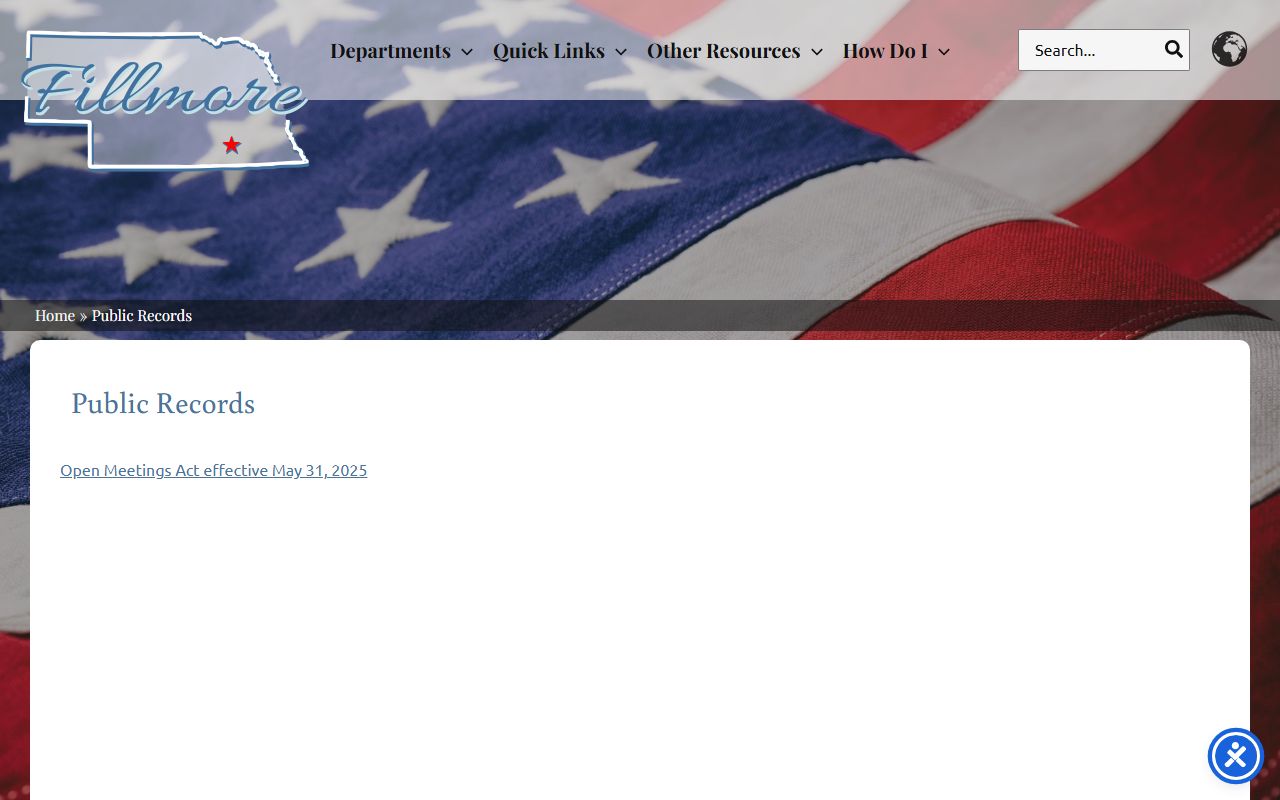
The limited local records page is why a booking-photo request should also use the sheriff's direct phone, fax, mailing, and in-person contact channels.
Sample Booking Photo and Record Field Inventory
No public Fillmore County roster sample was available for inspection, so the county should not be described as publishing a standard online photo card. Instead, a request should identify the photo and the related booking-record fields that help the sheriff locate the correct arrest. These fields are request targets, not promises that every item will be released.
| Field | What It Shows or Helps Identify |
|---|---|
| Booking photo | Arrest-identification photograph taken in conjunction with booking, if one exists and is releasable. |
| Full name and aliases | Identity information needed to distinguish the person from similar names. |
| Date of birth | Additional identifier that helps avoid misidentification. |
| Booking date and time | The jail intake date tied to the photo and booking record. |
| Arresting agency | Whether the arrest came through the sheriff, a local police agency, or another authority. |
| Booking or admission number | Internal identifier if assigned by jail records staff. |
| Charges or arrest allegations | Intake charge entries, which may differ from later court-filed charges. |
| Release or transfer status | Whether the person left the county jail, transferred, or remained in custody when the record was checked. |
| Court case number | Connection point for county or district court records after the arrest. |
Are Fillmore County Jail Mugshots Public Record?
Nebraska law supports public access to booking photos in a specific way. Neb. Rev. Stat. 29-3521 says criminal history record information does not include certain public-record information and includes photographs taken in conjunction with an arrest for purposes of identifying the arrested person in that public-record category. That does not create an instant online gallery, and it does not eliminate every possible withholding or redaction issue, but it is the main Nebraska citation for asking a sheriff about a booking photo.
Key Statutes:
Neb. Rev. Stat. 29-3521 treats arrest-identification photographs, police blotter entries, court records, wanted posters, and published arrest reports as public-record information outside restricted criminal-history record information.
Neb. Rev. Stat. 29-3523 governs criminal-history dissemination limits, removal from public record, sealing, and expungement in specific arrest or case outcomes.
Neb. Rev. Stat. 84-712 provides Nebraska's public-records access rule unless another statute expressly allows a record to be withheld.
Neb. Rev. Stat. 84-712.05 lists categories that may be withheld, including categories relevant to law enforcement, security, and protected information.
How Long a Mugshot Stays Public
Fillmore County did not publish a roster retention period because no official roster or photo gallery was found. There is no located county rule stating that a booking photo stays online only while the person is in custody, remains visible for a fixed number of hours after release, or moves into a searchable archive. The practical effect is simple: ask the sheriff whether the photo exists in the booking file and whether it is releasable under Nebraska law at the time of the request.
Public and not public: A booking photo may be public-record information under Nebraska law, but the county did not publish an online photo roster. Jail-security details, protected personal information, active investigative material, juvenile information, or records covered by another statute may be withheld or redacted. Custody status should always be verified with the sheriff or the office that created the record.
How to Write a Booking Photo Request
A strong request is narrow enough for the sheriff's office to process without guessing. Use plain language such as: I am requesting the booking photograph taken in conjunction with the arrest of the named person, along with the booking date, booking number if assigned, arresting agency, release or transfer date if releasable, and charge entry tied to that booking. Include the person's full name, date of birth if known, arrest date, and any court case number.
Send or deliver the request to the Fillmore County Sheriff's Office, 900 G Street, Geneva, NE 68361, or PO Box 266, Geneva, NE 68361. The office phone is 402-759-4441 and fax is 402-759-4429. Posted office hours are Monday-Friday, 8:00 a.m.-4:30 p.m.; the office is open through lunch and closed weekends and holidays. Ask whether the office needs a written request, whether fees apply, and whether the requested record can be emailed, mailed, picked up, or inspected in person.
Mugshot Removal, Sealing, and Neb. Rev. Stat. 29-3523
Nebraska law provides several criminal-history dissemination and record-removal routes, but they are legal-record remedies rather than a promise that every old copy of a photo disappears. Neb. Rev. Stat. 29-3523 addresses removal from public record, sealing, and expungement in specific circumstances. The research notes examples such as no charges filed after one year, diversion-related no-charge outcomes after two years, dismissed or acquitted matters, deferred or problem-solving-court outcomes, pardon-related sealing, and arrests caused by law-enforcement error.
A person seeking removal or sealing should focus on the official criminal-history or court-record path, not commercial mugshot sites. Do not pay or rely on unofficial photo-publishing pages as a substitute for correcting or sealing the underlying government record. Court outcomes, dismissed counts, and filed charges are separate from a jail booking entry, so a person may need to confirm the case status with the court and then ask the record-holding agency what order or statutory basis is needed for any restriction. Related court-record issues are handled through the criminal case, not through a photo gallery that Fillmore County did not publish.
State Prison, Federal, and ICE Photo Differences
County booking photos and state-prison records are different record types. If a Fillmore County defendant is sentenced to Nebraska state prison, the Nebraska Department of Correctional Services incarceration records search may show state-prison identity and custody data such as DCS ID, legal name, date of birth, demographics, facility, sentence terms, parole eligibility, release information, and current status. That does not make NDCS the holder of the original Fillmore County jail booking photo.
Federal and immigration custody also work differently. The BOP inmate locator generally shows name, register number, age, race, sex, release date, and location for federal prisoners from 1982 to present. U.S. Marshals handle federal pretrial custody and detention logistics but do not provide a general public inmate locator like BOP. ICE ODLS uses an A-number search or name, country of birth, and date of birth. Those federal and immigration tools are location and custody resources, not county mugshot galleries. No BOP prison, ICE detention facility, or U.S. Marshals detention facility was found physically in Fillmore County.
Avoid Commercial Mugshot Sites
The official-source path is the sheriff, Nebraska public-records law, the courts, NDCS when a person is in state prison, BOP for federal prison custody, and ICE ODLS for immigration custody. Commercial mugshot-publishing or pay-to-remove websites are not official Fillmore County records channels, were not used as sources, and should not be treated as proof of current custody, charges, release, or case outcome. A photo copied from an unofficial source may be stale, mismatched, altered by context, or disconnected from a later dismissal, acquittal, diversion, sealing order, or expungement process.